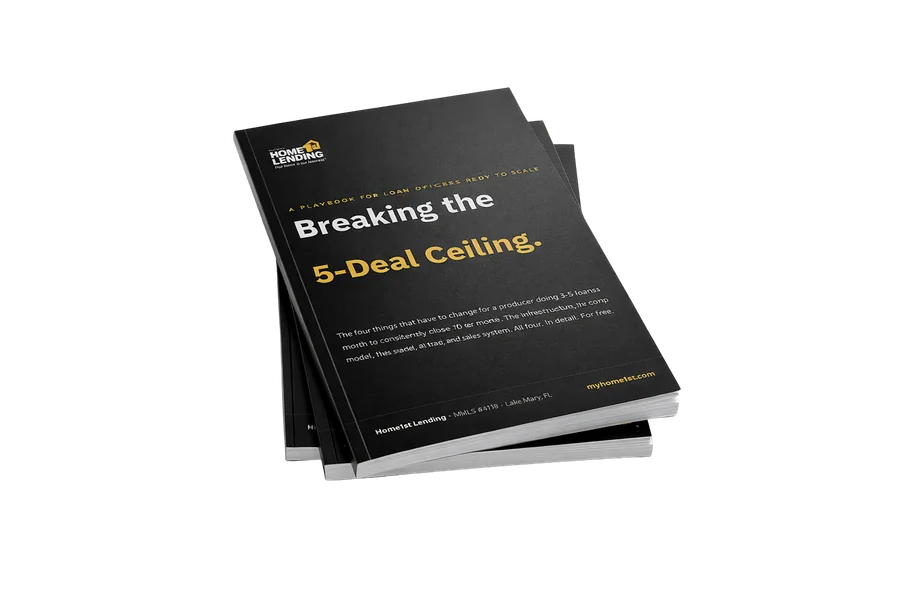
Free Guide for Loan Officers
Here's the exact system I built to help loan officers break past 5 deals a month, build a real team, and keep more of what they earn.
Who Is Zach Bleznick & Why Should You Care?
Zach Bleznick is the Team Leader of The Ace Group and a partner with Home1st Lending in Orlando, Florida. He's been in mortgage for over 20 years. Not 20 years of riding a good market. Twenty years that include filing bankruptcy during the 2008 crash, rebuilding from zero, and coming out the other side leading a company that does $400M+ a year in broker volume.
Along the way, he built a conversion system and trained his entire team on it. He figured out how to combine three support roles into a single hire at a fraction of what the industry charges. And he did all of it while being a present dad to four daughters.
But here's the part that matters to you: Zach has watched hundreds of loan officers hit the same wall. 3 to 5 deals a month. Working 60+ hour weeks. Knowing they should be doing more but unable to figure out how to hire, how to scale, or how to build a team without the math falling apart.
So he wrote everything he knows into a playbook. The staffing model. The comp audit. The brand framework. The sales system. Scripts, checklists, daily schedules. All of it. And he's giving it away for free.
These are Zach's results. Not typical. Results depend on market conditions, effort, and experience. Information shared here is not a guarantee of outcomes.

But hiring doesn't pencil out. A loan officer assistant can run you $60 to $80K. Add a processor and you're at $120K+ before you see a return. So you keep wearing every hat. Originating. Processing. Marketing. Admin. Follow-up. All of it.
Sound familiar?
Most solo producers never get past this wall. They stay stuck at 3 to 5 deals, burning out, wondering if this is just how it is.
It's not. There's a system for breaking through it.
Inside the Guide
Most LOs who try to scale make the same mistake. They hire another loan officer thinking they need help with leads. What they actually need is help with their systems. You are the brand. Don't dilute it. Hire infrastructure, not competition.
The guide introduces the LEA Model: Loan Executive Assistant. One person who covers three roles you're currently doing yourself. Executive assistant, inside sales, and loan officer assistant, sometimes referred to as the LP1/LP2 model, merged into one trained hire. At roughly $30K a year instead of $120K+.
In this section, you'll see:
Here's a conversation nobody in this industry is having honestly with you. You've been told what you're getting paid. You've never been shown where the rest of it goes.
Most retail LOs land around 120-125 basis points. You're told that's competitive. But above you there's a branch manager, a district manager, a regional VP, a divisional SVP, and a corporate layer. Every one of those people is getting paid out of your production.
This section isn't a pitch for a specific company. It's a framework for evaluating any comp model, including the one you're on right now.
In this section, you'll see:
At 3 to 5 deals a month, your business runs on a small circle of relationships. Maybe 3 or 4 agents, some past clients, some sphere. That works until it doesn't. Those relationships have a ceiling. You can only extract so many referrals from the same handful of people.
To consistently do 10+, you need agents who've never met you to have already heard of you. And if they Google you, they need to see something real. A team name. Content. An identity that says "this person is serious."
In this section, you'll see:
Infrastructure gives you the time. The right comp gives you the margin. Brand gives you the reach. But without a system for every conversation, the rest doesn't matter.
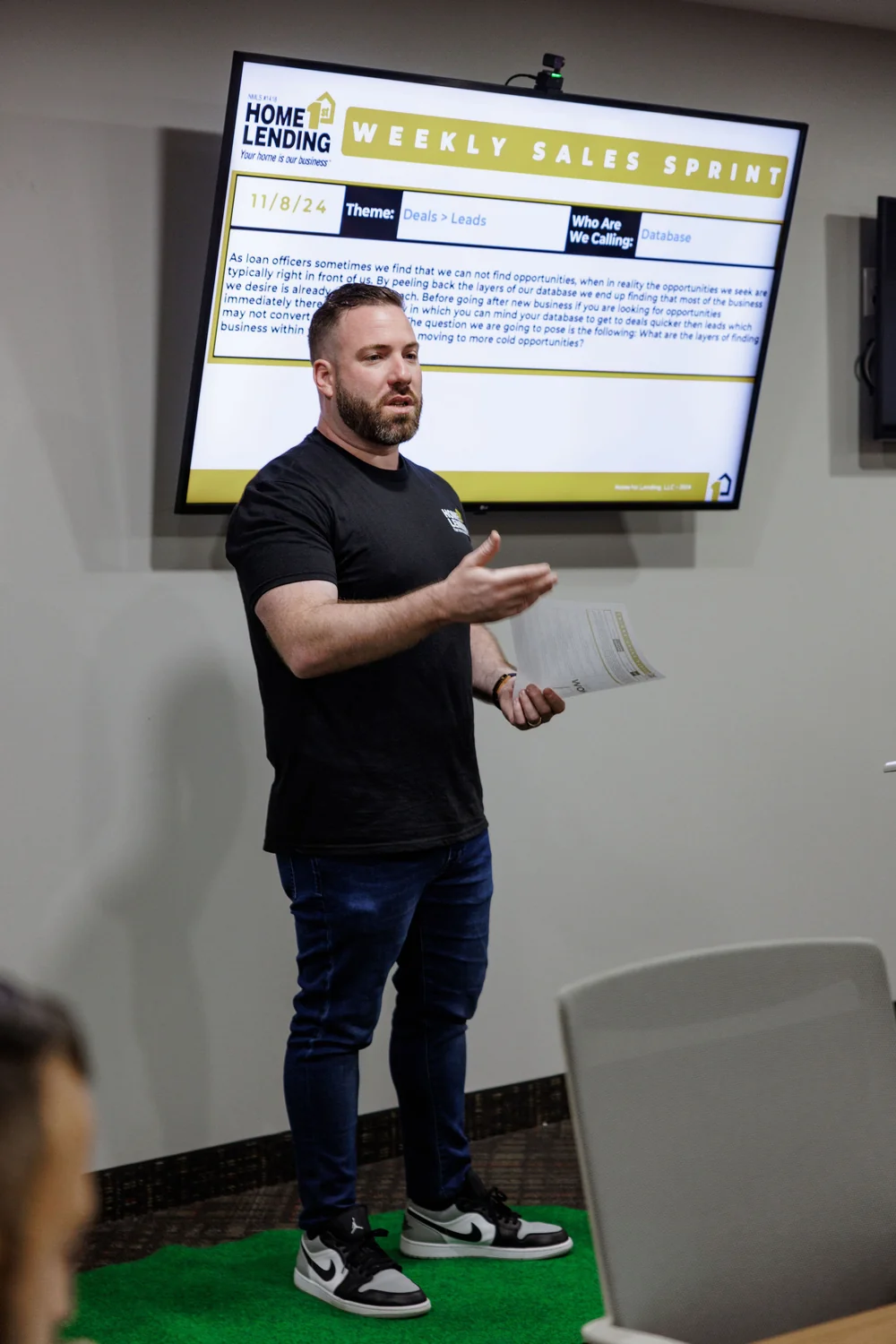
This is the most tactical section of the guide. Word-for-word scripts, a proven call framework, objection responses, and a business generation model you can implement this week. Not theory. Not motivation. Actual words to say on actual calls.
In this section, you'll see:
Most loan officers who try to build a team spend $140K+ a year on support staff. A loan partner and a processor. That's before you see a single dollar of return. It's the reason most solo producers never hire.
That's $110K+ back in your pocket every year. Same support. Same output. Fraction of the cost. The guide breaks down exactly how the staffing model works and why it costs what it costs.
Case study results are not typical and depend on individual effort, market conditions, and experience.
From Zach's desk:
I filed bankruptcy at 21 years old.
I had the BMW. The townhouse. The credit cards. The designer shoes. Then 2008 happened and all of it was gone. My $233,000 house was worth $80,000 overnight.
Most people left the industry. I stayed. Not because I'm tougher than anyone else. Because I didn't have anywhere else to go.
That turned out to be the best thing that ever happened to me.
Over the next 15+ years, I rebuilt everything from zero. I learned what actually works. I figured out how to build a team without going broke doing it. I figured out how to keep my brand, keep my comp, and build systems that let me be home for my four daughters.
This guide is the system I wish someone handed me when I was stuck at 3 deals a month, wearing every hat, wondering if it was ever going to get better.
It does. But only if you have the right infrastructure.
Download the free guide. See the full system. Decide for yourself if this is the infrastructure you've been missing.